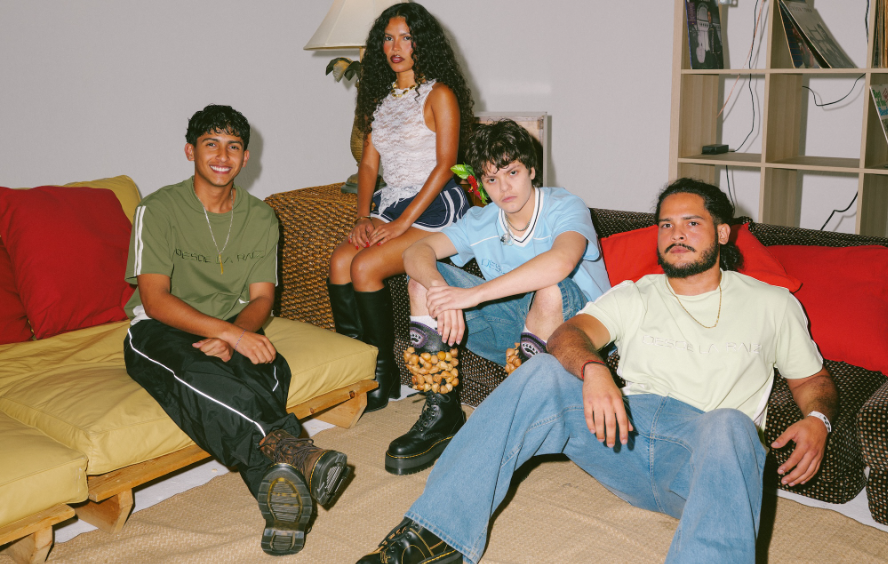
Few bands get to play a stadium before releasing their first studio album. For Puerto Rican four piece Chuwi, that opportunity has already taken them to dozens of stadiums and introduced their music to thousands of people at a time.
Life has changed dramatically for siblings Willy, Lorén and Wester Aldarondo Torres and Wester’s school friend Adrián López Soto since they were invited in 2024 to contribute to Bad Bunny’s acclaimed album ‘Debí Tirar Más Fotos’. Looking back on recording ‘Weltita’, Willy still sounds moved. “It’s hard to explain how it all felt,” he reflects.
“We were just starting in the local scene in Puerto Rico, and suddenly something like this got dropped onto you. We obviously had to put the initial shock to the side and focus on the song, but after, it’s like, ‘What on earth is going to happen now?’ Nobody could have predicted what happened after, where we would be, and where we are now.”
The months that followed have felt almost impossible to keep track of. After the album arrived, Chuwi joined Bad Bunny as his sole opening act on a world tour through Latin America, Australia and Europe. Their nearly yearlong journey ended only hours before their conversation with NME, following two closing shows at Puerto Rico’s Hiram Bithorn Stadium.
“It was euphoric,” Wester recalls. Taking their culture overseas, then returning home with memories from every destination, meant more than he could put a price on. López Soto shares that feeling, particularly when remembering the emotion of those final performances. “There’s a point in all our shows when we perform ‘Tierra’ where I bring out the Puerto Rican resistance flag and that of the country we’d be performing in. Having the Puerto Rican flag and the resistance flag together, and everyone deeply understanding both of them, was unforgettable.”
Chuwi began during the COVID pandemic in Isabela, a municipality in northwestern Puerto Rico, where Willy, Lorén and Wester started experimenting with recordings. Their parents’ bedroom became their makeshift studio and remained their main recording space until recently. When their first invitation to perform arrived in late 2021, López Soto, who comes from Mayagüez, joined them on percussion.
All four grew up with music woven into everyday life. For Willy, learning about production began with his father. “He used to recreate Jesús Adrián Romero songs from scratch for the church we grew up in,” he recalls to NME. He credits their mother with broadening their listening habits. “She would drive us to and from school while playing all sorts of music – from Latin and Caribbean music to American pop and beyond,” he explains. López Soto’s interest started with turning household objects into instruments. “I’d take our pot and turn it upside down to create my own drum set, so my mum signed me up for music lessons from the fourth grade up until I graduated with Wester,” he remembers.
Caribbean music and Puerto Rican traditions remain central to their sound, with influences including Juan Luis Guerra, Silvio Rodríguez, Haciendo Punto en Otro Son, Ricky Martin and Marc Anthony. But their songs reach beyond those foundations, pairing salsa and plena with contemporary indie sounds and the emotional storytelling of Spanish pop group Mecano. Willy points to ‘Mundi’ as a song where Mecano’s influence is especially clear. Wester’s listening also takes in Black Eyed Peas, Skrillex, Empire Of The Sun and Foster The People. “It was all that mix throughout different phases of our lives that united to create us,” he reflects.
Those varied tastes first surfaced in atmospheric R&B recordings such as their debut song ‘Somnia’, whose artwork features the family dog, Chewie. Their sister Álani, who is not a band member, brought him home as a puppy, and he remains part of the family. He also gave the group its name, almost by accident. “We were about to upload the song to platforms and then were like, ‘Wait, what’s the group name going to be?’ Then we saw Chewie lying in bed in our parents’ room, and I remember being like, ‘Fuck it, Chuwi,’” Wester remembers. Adapting the spelling from its Chewbacca reference to the “more Hispanic-sounding” Chuwi felt natural, much like the title of their 2026 single ‘Plei’.
“I hope to empower the next generation to keep making music from our home”
Willy Aldarondo Torres
Moving beyond their initial R&B and downtempo recordings, Chuwi gradually embraced a stronger Latin direction, perhaps helped by Adrián joining the group. The plena and salsa they had grown up with became more prominent across their EPs ‘Pan’ in 2022 and ‘Tierra’ in 2024.
“After releasing ‘Pan’ and ‘Tierra’, we started making the rounds in Puerto Rico’s local circuit,” Wester recalls. “People started speaking of us as a band, and we just took it in stride. But I still feel like we are transitioning from [experimenting at home to being a live band].”
A year of supporting Bad Bunny has given Chuwi plenty of opportunities to develop as performers, alongside their own concerts and shorter tours. Travelling also gave them space to reflect, and those experiences have fed into their debut album, due later this year. According to Willy, Caribbean music will remain its foundation, joined by “foreign” influences gathered from “all around”. “They cross borders and time zones,” he explains.
With their audience growing, choosing a full album over another EP felt like a deliberate next step. “An album is like an introduction to a wider and newer audience, and we felt like it was time,” Willy explains. “This album closes a sort of trilogy that we started with the two previous EPs, and this being the third chapter, it deserved to be a longer project.”

Experiencing new places widened the band’s perspective and helped shape the record’s sound, with the finishing touches completed while travelling. They describe it as their boldest and most political release so far “in a lot of ways”. Willy shares: “We don’t know what the reception is going to be, but we feel really happy and proud with what we have made with this album. We love the songs, and we hope people love them too.”
Across their releases, Chuwi have become increasingly outspoken about everyday experiences in Puerto Rico and its diaspora. That shift happened naturally. Lorén, who could not attend the main interview, explains in a voice message sent to NME the following day: “We started making music because we missed creating and we missed being surrounded by music. All we could sing about was what we were living and experiencing. We didn’t have anything else to talk about. Our music is now viewed through a social-political lens, and that’s very cool. We love it, but really, it came from the general intent of living normal lives and realising that, in our normal lives, things are missing.
“The promises we were told as children are not real. The world has changed. It’s not easy owning a house. It’s not easy paying rent and having to buy a car because there’s no public transport system. They are real situations for us, so it’s easier to write about them than love. It’s important for us, and that’s where our musical muse is born.”
Their willingness to speak openly about their experiences and convictions has helped bring Chuwi wider recognition, including a place in the NME 100 of 2026. Through their performances and conversations away from the stage, they hope to connect with listeners and encourage others to express themselves freely.
“My hope is for more Caribbean music to be made,” Willy shares. “For it not to become stagnant as it has, and is still sadly happening. I hope to, in some way or another, empower the next generation to keep making music from our home and maybe speak about things that make them feel as strong[ly] as we do.”
Chuwi’s first studio album is due later this year.

.JPG)